

Peter's Model Railroading | The Layout | Hazel Mine, Canonsburg, PA - Module #3
Design #3


This image is from shortly after the tipple was built. The third module will cover the left-to-right space from the tipple to the right-hand edge of the power house. The power house is the large building in the back with the four smoke stacks. It used leftover coal and other fuels to power a generator which provided the electricity to run the entire mining operation. In addition to the tipple, it also operated the incline's system, as well as all of the electrical needs in the huge mine under Buffalo Hill.

This photo shows the tipple being expanded several years after its construction. It was dated 1902 (the tipple was built in 1900). The power house was necessary because the city of Canonsburg couldn't provide enough electricity to run the whole operation. In addition to the power house, a single locomotive water tower is visible in front of the yard tracks of the tipple. Note that immediately to the right of the water tower is some sort of small shack. There is also another large building to the right of it.

This track view is of the yard tracks leading up to the tipple, with the power house on the right and the water tower on the left. In between the box car on the left and the water tower, the small shack is visible. The partial roof visible above the box car is from the larger building.

The reason for mentioning this is because of the gradual changes that were made to this area that I plan on modeling in the third module. I believe this photo was taken from the raised walkway bridge that spans the yard tracks (to be modeled in my fourth module). This photo was taken in winter time as there are icycles hanging down from the tipple's and power house's roofs. Other things this later photo shows is the fact that the aforementioned shack is gone and a second water tower was added immediately adjacent to the first one. Also visible in this photo is a small brick lean-to in the front of the power house on the right. This lean-to didn't appear in the above photos, so that is a new addition. Although hard to spot, unless you know what to look for, there appears to be more than four smoke stacks on the roof of the power house. The final thing to note from this photograph is that the yard tracks pretty much curve the entire way to the tipple. I do not see any turnouts in this area.
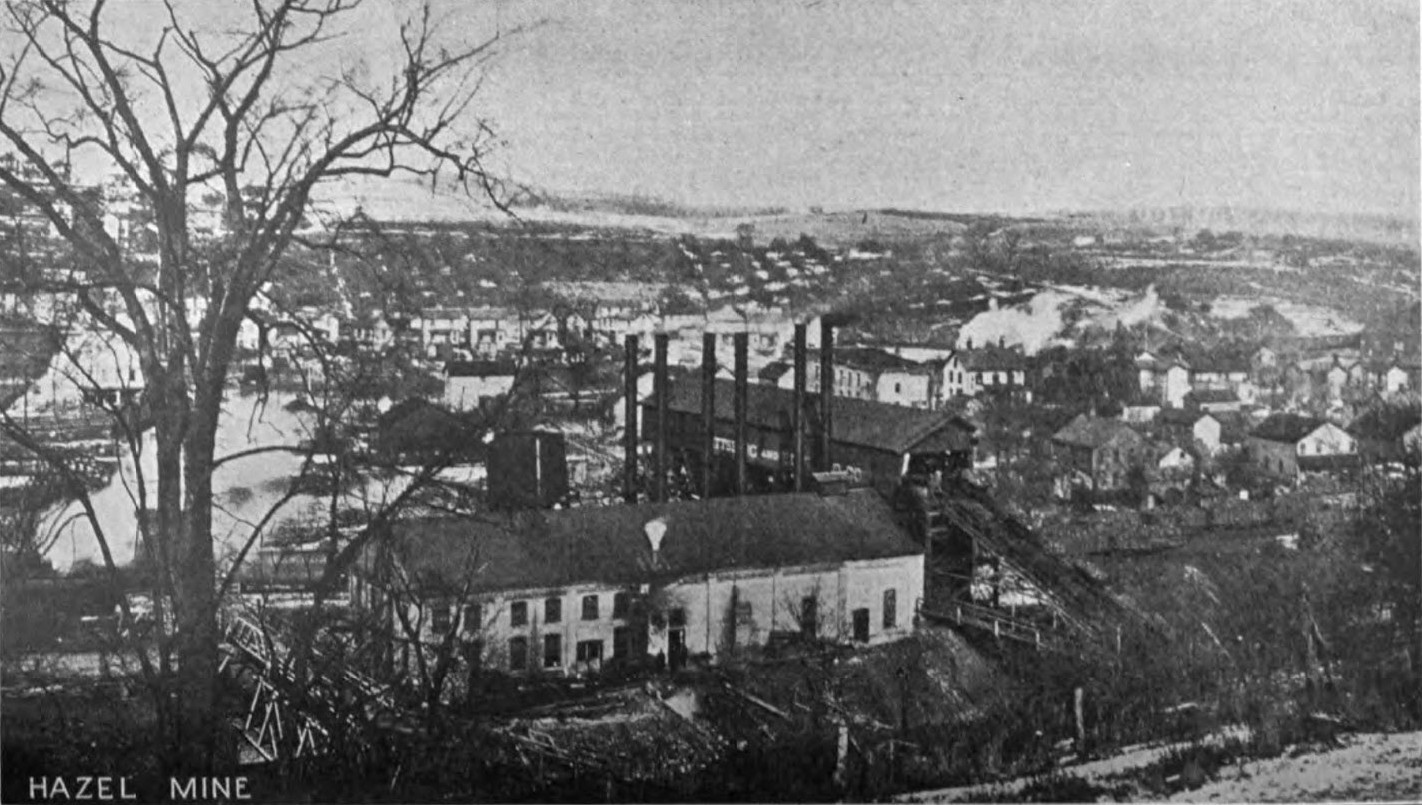
This photo was taken from Buffalo Hill. You can see the creek side of the power house, and it is now obvious that by the time of this photograph, the power house had six smoke stacks. To the left of the power house you can see the walkway bridge that spans the yard's tracks, from which the above-mentioned photo was likely taken. This photo does, however, still only show the one water tower, so it dates from after the tipple was expanded, but before the second water tower was added. Upon further study of this photo, it seems that the two "6-inch water pipes" marked on the Sanborn map are visible going across the creek at about the center area of the back of the powerhouse. They appear to be underground under the building, but than can be seen when the cross the creek. I will probably model that as well, even though they may not be fully visible.

All of this available prototype information is then used to help analyze the Sanborn map for that area. This map is signed and dated November 1913. The map shows the six smoke stacks of the power house, and it also identifies the lean-to as the "fan house". Since Sanborn was an insurance company, knowledge of nearby water sources was vital to its records, so we can be fairly sure that those are accurate. Surprisingly, yes, the two water towers shown in the photographs above are visible (two individual side-by-side units), but a third dual-water tower unit is also shown. It is marked as "Softening House". It also draws the five yard tracks at a continuous curve with no turnouts. The larger map, from which this was taken, does show the tracks all merging into one, farther to the left of this image's orientation. The final thing to note is the fact that the creek juts away from the power house quite quickly after the tipple's incline. This explains why there is so much space between the back of the building and the creek in the photo above.

The whole purpose of the above "evidence" and documentation, is to determine what is actually going to be covered in the 1:64 scale, 2' x 4', module #3. Rotating the Sanborn diagram by 8 degrees I get a very close match to what I will be modeling in this module. The 2-foot wide module just fits the prototype dimensions of the power house. The creek widens out quite a bit in the back, so I will only be modeling the back embankment for about half of the module. The track orientation is pretty well determined by this diagram. I have not found any photographs showing the dual water tower, so I may have to "freelance" that a little bit, and I will have to think about building it as if it is sliced open at the front of the module, or simply stick out over the edge a bit (dangerous). The power house is smack up against the coal tipple and its incline. It will be the main focus of this module and where I'll be spending a good amount of time.
After that, I'll be building the water towers, to complete the module. I am also thinking about incorporating a couple of sound modules into the power house, to simulate the sounds produced by the power house, the tipple, and the water towers.
Note that, as far as I have been able to deduce, some time in the 1930s, the power house was removed as the mine was able to tap into the city of Canonsburg's electricity grid. Believe it or not, this was actually the major motivation for me to model 1924, because I really, really wanted to model this power house.
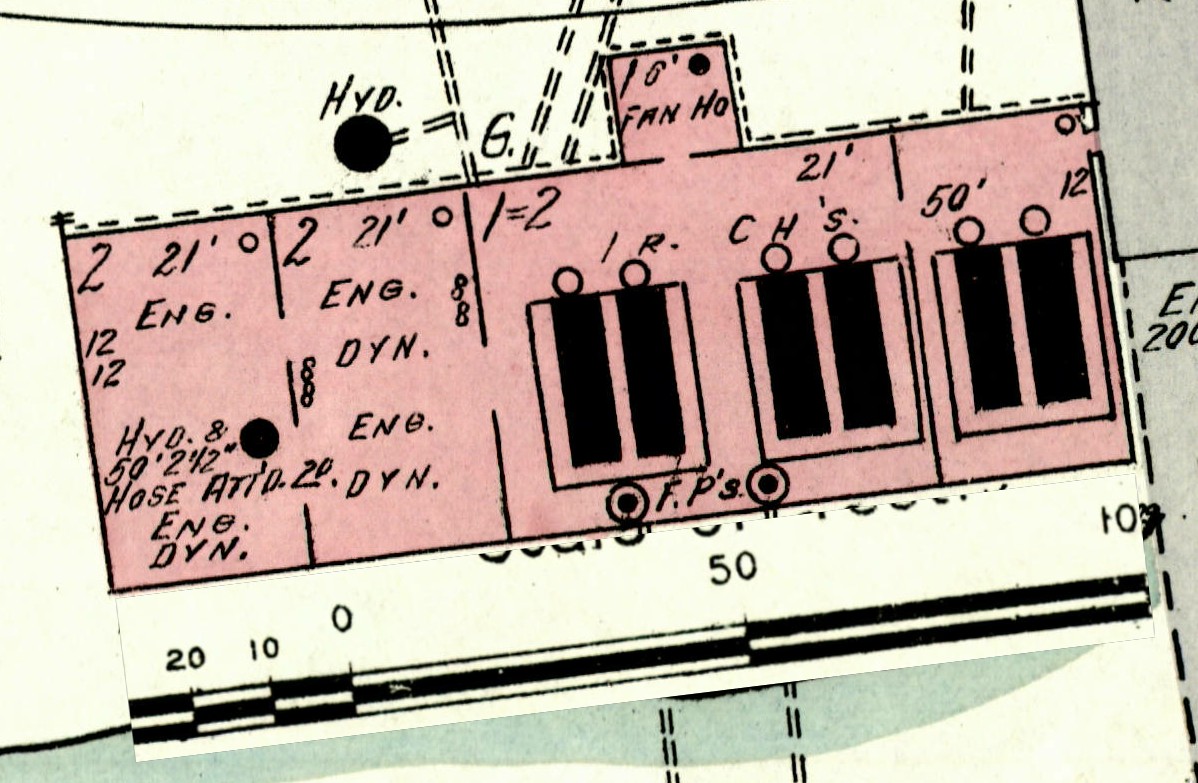
To prove to myself that this power house does indeed exactly fit within my S-scale 2-foot-wide module, I took the scale on the Sanborn map, "trimmed" it to as close to 128 scale feet as I could, rotated it 8 degrees to match the original position of the building, and then plopped it right under the building. Two feet in S comes out to 128 scale feet, and I suspect the building is about 130 feet wide. Extremely close. So, I can continue with my plan to build this scene without selective compression. More details and measurements will be shared when I get around to actually building this structure. For now I just wanted to make sure that I was on the right track.
With this, let's get to building!...